
A Perfect Day: From Forres to Culloden, Fort George and Findhorn
Every journey I design begins with a sense of place, of time, and of connection. The perfect tour unfolds gently—layer by layer—revealing Scotland’s landscapes, history and spirit in ways that surprise, delight, and linger long after the day has ended.
This day begins in Forres, a royal burgh with roots stretching back over a thousand years. We meet in the morning, not with a rush but with a pause: coffee in one of the town’s independent cafés. It’s a chance to settle into the day, to share expectations, and to savour the simple pleasure of a Highland welcome.
We leave Forres behind, taking the back roads rather than the main routes. These winding lanes pass through farmland and forest, by hamlets and standing stones most visitors never notice. This is the Scotland that locals know—the dry-stone walls, the shifting colours of the fields, the subtle changes in light as the Moray Firth disappears and the moors begin to open. The journey itself becomes part of the story.
Culloden – a human tragedy
Not too much later, we arrive at Culloden. Few places in Scotland carry such weight. It was here, in April 1746, that the Jacobite Rising came to its bloody end. I guide you across the battlefield, pointing out landmarks: the memorial cairn, the clan graves, the marshy ground that proved so costly. But this is not simply a military account. It is a human story—of ambition, loyalty, loss, and the reshaping of a nation. Standing on that moor, with the wind brushing your face, it is impossible not to feel the poignancy of what happened here.
After our exploration, we break for lunch. Whether in the visitor centre café or a nearby inn, the focus is on Highland fare—simple, seasonal, and sustaining.
Our next stop lies a few miles away: Fort George. Built in the aftermath of Culloden, this vast star-shaped fortress was intended to stamp authority on the Highlands. Its scale is astonishing—mile-long ramparts, barracks for thousands, and defences stretching into the Moray Firth. Yet today it feels serene, its walls softened by sea air and lichen. From the ramparts, we may glimpse dolphins in the firth below before wandering through the Highlanders Museum. The regiments’ history is told in medals, uniforms, letters and artefacts—each a thread in Scotland’s military past.
There is time to explore at your own pace. Some linger in the chapel, where silence speaks as loudly as any exhibit. Others prefer the views—the sweep of the firth, the openness after Culloden. For me, the two sites are inseparably linked: Culloden’s tragedy and Fort George’s response, two sides of the same coin.
Findhorn – unique spirit of community
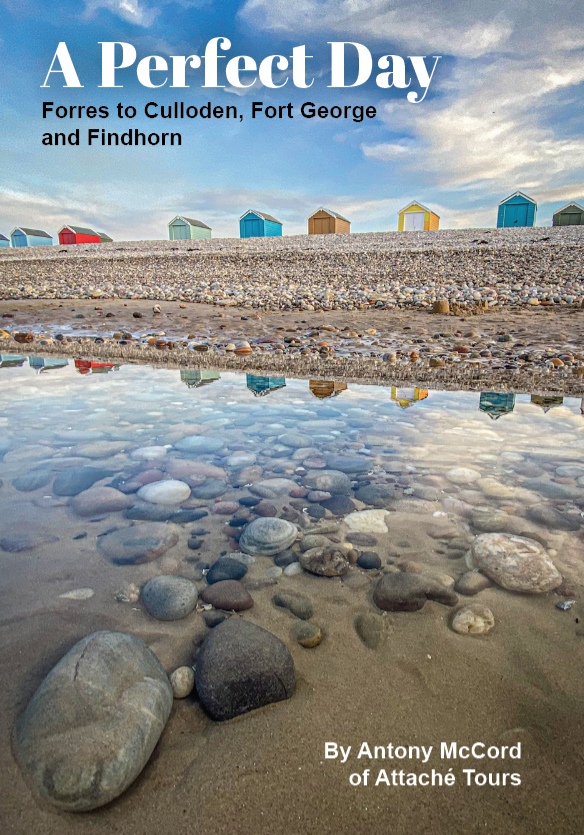
As the afternoon draws on, we take the road back to the coast. Our destination is Findhorn, where sea, sky and sand meet in spectacular harmony. Once a fishing village, today Findhorn is known for its sweeping beach and the unique spirit of its community. The light on the water is endlessly changing—silver, gold, deep blue.
And then, as evening approaches, we gather in one of Findhorn’s characterful pubs for dinner. Whether freshly caught seafood, locally reared beef, or simply fish and chips with a pint, the meal is relaxed, convivial, and rooted in place. It is the kind of dinner where stories are exchanged, the day’s highlights shared, and the sense of community felt as keenly as the taste of the food itself.
It is in Findhorn that the day comes to its close. For me, it is the perfect ending—an invitation to reflect, to breathe, and to let the experience settle before the journey home.
Throughout this day, what matters most is not the number of miles travelled or the sites ticked off. It is the connections made: between past and present, between landscape and story, between traveller and guide. My role is to weave those threads together, creating a tapestry that is both memorable and meaningful.
Curated, not crowded
As we part company at the end of the evening, my hope is that you carry more than photographs. I hope you carry a sense of connection: to the land, to its history, and to its people. Because the perfect tour is never just about where you go. It is about how you feel when you get there, and what stays with you afterwards
This tour, from Forres to Culloden, Fort George and Findhorn, embodies what I strive to offer through Attaché Tours. It is curated rather than crowded, thoughtful rather than hurried. It offers context as well as content, space as well as structure. Above all, it leaves you with a sense of having touched something authentic—something that belongs to Scotland, yet is shared with you.
– Antony McCord, founder of Attaché Tours